
HALO Procedures Need Teams
by: rod
HALO Procedures Need Teams.
Resuscitative thoracotomy is one of the very few true HALO procedures that every resus room team needs to know and practise.
It is high acuity, low occurrence – and when it is needed, there is very little time to work out who does what.
That’s why we don’t teach it as a procedure performed by one clinician.
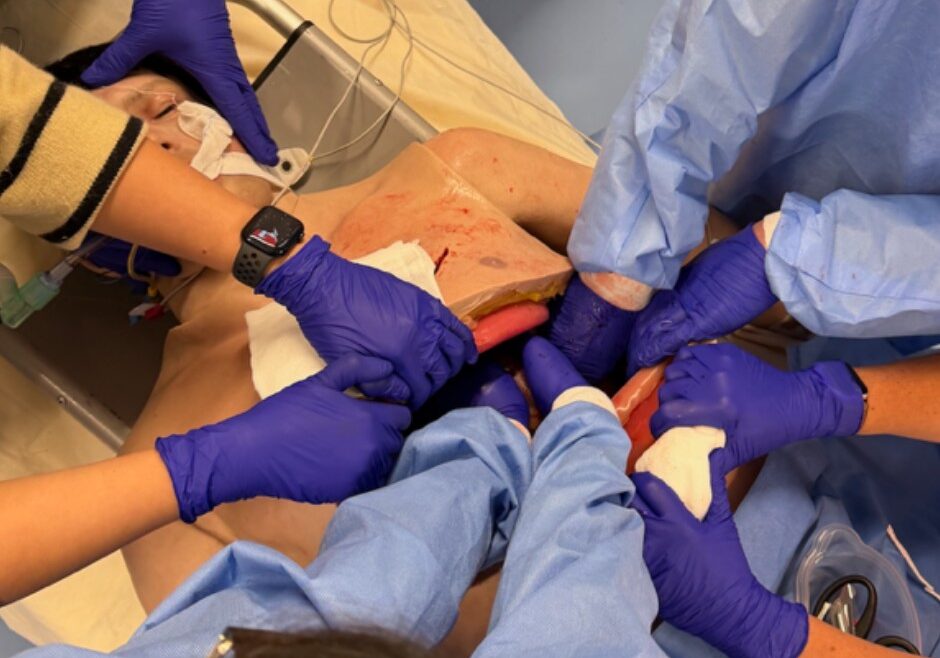
Look at the hands in this photograph.
Effective resuscitative thoracotomy requires clear leadership, defined roles, closed-loop communication, anticipation and shared situational awareness. People need to know not only what they are doing, but what the team is trying to achieve and what is likely to happen next.
Equipment needs to appear before it is requested. People need to work simultaneously without getting in each other’s way. The team needs to communicate clearly while maintaining the rest of the resuscitation around an extraordinarily invasive procedure.
And there is another lesson.
In my experience, resuscitative thoracotomy often feels remarkably binary.
It either works, or it doesn’t.
And when it works, things can change very quickly.
The team that, moments earlier, was performing a thoracotomy in traumatic cardiac arrest may suddenly have a patient with ROSC.
Now the priorities change.
Haemorrhage control. Ventilation. Temperature. Blood products. Physiology. Anaesthesia. Transfer to theatre. Damage-control resuscitation and critical care.
The team needs to change gear without losing momentum.
Since launching the ResusPro Thoracotomy + Course, we have trained more than 100 clinicians in resuscitative thoracotomy, in partnership with the Cambridge Major Trauma Centre and Cardiac Advanced Resuscitation Education, using the fantastic Safeguard Medical Thoracotomy Trainer.
What did we learn? Knowing how to perform a thoracotomy isn’t enough.
The whole team needs to know how to make it happen – and what to do when it works.
