
The Environment Is Part of the Training
by: rod
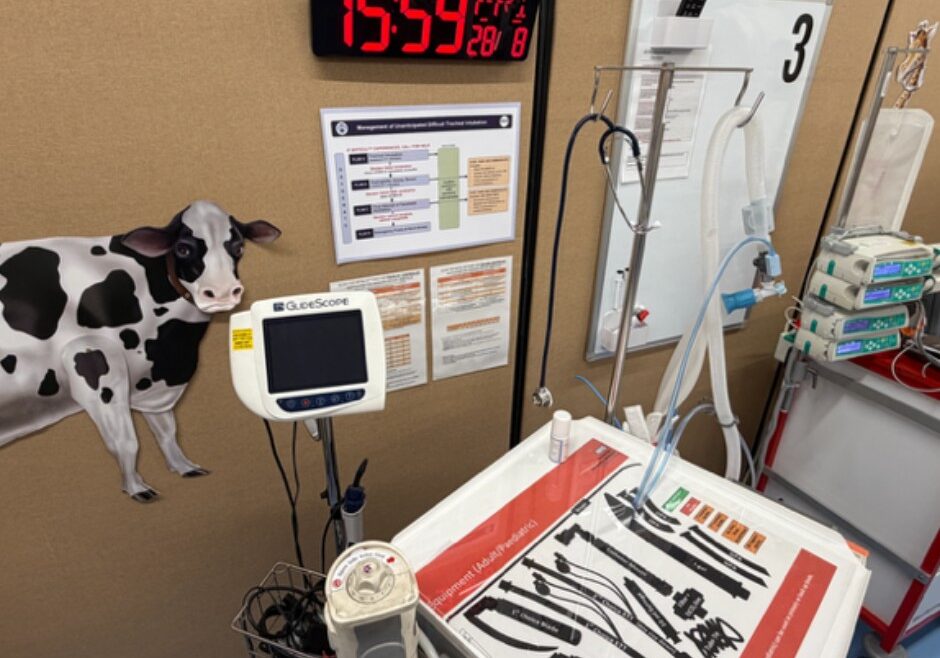
This is Bay 3 at ResusPro.
There’s nothing particularly dramatic happening.
But almost everything in this picture is there for a reason.
A clock you can see.
A difficult-airway algorithm where you might actually need it.
A GlideScope ready to use.
Suction. Ventilation. Syringe pumps.
Equipment organised and labelled so that people can find it under pressure.
And a cow.
When we started building ResusPro, it was tempting to think that realistic simulation just meant realistic patients.
We’ve learned that the environment matters just as much.
In real resuscitation, clinicians don’t work in isolation from their surroundings. They look at clocks, reach for equipment, follow cognitive aids, move around one another and develop a shared understanding of where things are.
So we don’t just put a manikin in a room and create a scenario around it.
We try to create a working resuscitation environment – and then let the team work within it.
Because immersion isn’t only about how realistic the patient looks.
It’s about whether the room behaves like somewhere you might actually resuscitate one.
